

Saona Island from Punta Cana: An Honest Guide to the Boat Tour
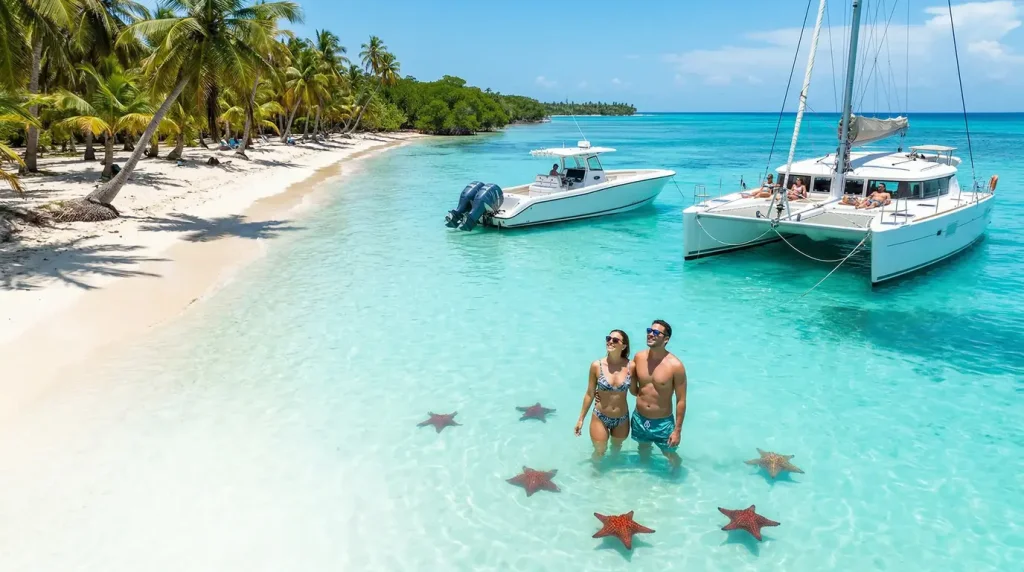
Short answer: Saona Island is a small uninhabited Caribbean island off the southeast coast of the Dominican Republic, inside Cotubanamá National Park. It's the most popular day trip from Punta Cana, and the experience comes in two very different versions: a high-volume "cattle boat" group tour, or a private charter. Both leave from Bayahibe — about an hour west of Punta Cana — not from Punta Cana itself. Here's what each option actually looks like, plus the history nobody at the resort is going to tell you.
Wait — the boat doesn't leave from Punta Cana?
No. Every Saona Island trip — group tour or private charter — departs from Bayahibe, a small fishing town about an hour's drive west toward La Romana. There is no faster route. The geography of the coastline puts the launch point there.
If you booked a "Saona Island tour from your Punta Cana hotel," what you booked is a van pickup → 60-minute van ride to Bayahibe → boat. The same goes for hotels in Bavaro, Cap Cana, or Uvero Alto. (For more on why your Punta Cana hotel probably isn't actually in Punta Cana, see Bavaro vs Punta Cana.)
The cattle-boat experience
Thousands of tourists leave Bayahibe for Saona every single day. To move that many people, the operators run a clever rotation: you get one type of boat going out, and a different type coming back. Specifically, speedboat one direction and sailboat the other. You don't get to pick which is first — the locals work it out based on capacity and timing.
In my opinion, speedboat to Saona, sailboat home is the better order. You don't have a choice in the matter, but here's why one direction is better than the other.
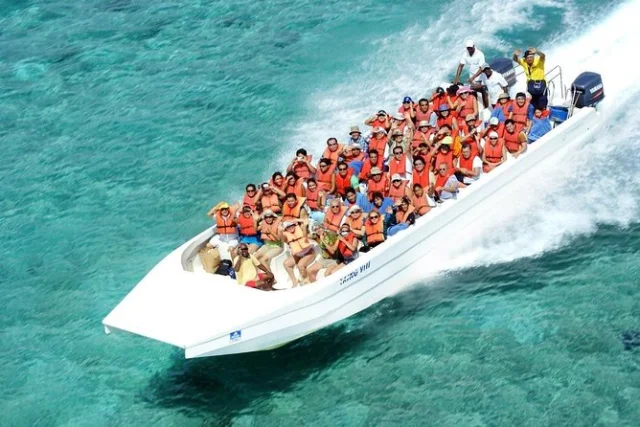
Speedboat going out. You get there faster. The boat usually stops at a famous shallow sandbar where you can wade in waist-deep water and see (and gently touch) live starfish. The rest of the ride is an adrenaline bounce over the swells — wind in your face, salt water in your hair. Holding a drink is essentially impossible. You arrive on Saona earlier than the sailboat groups, so the beach is less crowded for the first hour.
The trade-off: you also leave earlier, and you leave on the sailboat. That's where the math gets interesting.
Sailboat coming home. The "sailboat" is a roughly 70-foot catamaran-style party boat that holds around 100 people. The definition of a cattle boat. But here's the thing — the ride home is when the operators turn it into a party. Unlimited drinks, music, dancing. If you got seasick going out, ate something questionable on the island, or just had a long hot day, the ride home tends to smooth all of that over. People get off the boat in much better spirits than they got on.
If you do it in reverse — sailboat out, speedboat home — you arrive on Saona later (more crowded), already mildly drunk, and your return is a wet bumpy ride with no drinks. Same trip, very different memory.
That's the cattle-boat experience. It's not a bad day. Tens of thousands of people a month do it and most have a good time. Just understand what you're booking: a high-volume group tour, on a beach with thousands of other people, with a built-in party on the way home.
The private charter experience
A private charter is a different product entirely.
One boat. Just your group. Family, friends, whoever you invited — no strangers. The vibe is whatever you want it to be. Loud music and a not-safe-for-work party? Yours. Quiet day on the water with your kids? Also yours. The boat doesn't have to play to the lowest common denominator the way a 100-person catamaran does.
A different part of Saona. Private charters don't dock at the same beach the group tours flood. You go to a quieter, more secluded section of the island, away from the thousands of day-trippers. The Caribbean is the same Caribbean — but the experience around you is completely different.
Better food. Whatever you order is what you get — no buffet line, no plastic plates.
Same starfish stop, if you want it. The sandbar / natural pool is on the way; private charters can stop there too. You're not missing it.
The cost. A private charter costs significantly more than a cattle-boat seat. There's no way around that math. What you're paying for is the absence of the other 99 people, and the freedom to make the day yours instead of the operator's.
Cattle boat vs private charter — side by side
| Cattle boat | Private charter | |
|---|---|---|
| Group size | ~100 strangers | Just your party |
| Boat | Speedboat one way, party catamaran the other | One boat, round trip |
| Beach on Saona | The crowded main beach | Secluded area away from the main crowd |
| Drinks | Unlimited on the sailboat leg | Whatever you want, however you want |
| Food | Buffet | À la carte |
| Vibe | Set by the operator | Whatever you decide |
| Starfish / sandbar stop | Yes | Yes |
| Cost | Lowest | Significantly more |
Neither is "right." They're different products for different days.
What you actually see on Saona
Saona Island sits inside Cotubanamá National Park (formerly the National Park of the East). It is uninhabited except for one small fishing village, Mano Juan, on the south coast — pastel-painted wooden houses on the sand, a few fishermen, a small school. You may or may not stop there depending on your tour.
The main attractions for almost every visitor:
- The natural pool / sandbar. A waist-deep stretch of crystal-clear water about a mile offshore, full of live starfish. The classic Caribbean postcard image.
- The beaches. Long stretches of white sand, clear water, palm trees, the works.
- Lunch on the island. Some version of grilled chicken or fish, rice, salad. Cattle-boat tours do a buffet; private charters do whatever you arrange.
- The water itself. This is genuinely some of the clearest, calmest Caribbean water you'll find anywhere. That's the real reason people come.
What Saona is not: an island with a town, a hotel, shopping, or anything beyond the natural beauty. You go for the beach and the water. That's the whole point.
The history nobody tells you on the boat
Saona Island has a story — and a name behind the national park — that almost no tour guide gets into. It's worth knowing.
The Taino last stand
The year was 1502. The Taino people, the native population of Hispaniola, had been on the island long before Columbus arrived in 1492. They were not a warlike people — they're actually credited with inventing the hammock. But after a decade of Spanish enslavement and forced labor in mines and plantations, some of them began to fight back.
In the east of the country — in Higuey and on Saona Island — resistance was led by a Taino chief named Cotubanamá.
A peace negotiation goes wrong
When Hispaniola's first governor, Nicolás de Ovando, arrived in 1502, his goal was straightforward: pacify the natives and put them to work. He faced immediate resistance in the east. Ovando sent soldiers to negotiate. The talks were supposed to be peaceful, but during the negotiations a Spanish attack dog mauled and killed a lower cacique (chief).
The Tainos were furious. Cotubanamá sent out word that the rebellion was on.
The ambush at Saona
Not long after, a group of Spanish sailors made a casual stop at Saona Island on their way to Puerto Plata on the north coast. An innocent leg-stretch on a Caribbean beach. The Tainos were waiting. They ambushed the Spaniards and killed them all.
When word reached Ovando, he sent 500 soldiers to crush the rebellion and capture Cotubanamá.
The massacre
The Spanish historian Bartolomé de las Casas described what happened next as "a massacre in which hundreds of Taínos perished, of all sexes and ages." The natives — armed with bows, spears, and clubs — were no match for steel armor and crossbows. Those who weren't killed were enslaved. Some had their hands cut off. Roughly 4,000 Tainos were sent in chains to Santo Domingo.
Through the torture of captured natives, the Spanish learned that Cotubanamá was hiding in a cave on Saona Island with his family and his best warriors, planning a counterattack. The Spanish moved first. They surprised the camp and captured him.
The execution
Cotubanamá was transported by ship to Santo Domingo and handed to Governor Ovando. The charges:
- Setting fire to the home of Juan Ponce de León (yes, that Ponce de León) on three separate occasions.
- Evacuating women, children, and elders to safer parts of the island.
- Resisting and fighting against the Spanish.
He was hanged in a public plaza in Santo Domingo. The Spanish tried to erase his name from history.
The name comes back, 500 years later
On October 8, 2014, Dominican President Danilo Medina signed Decree 519-14, which officially renamed the National Park of the East to Cotubanamá National Park — the park that contains Saona Island.
In the signing, Medina said: "The chief Cotubanamá was a great defender of his race, which is why the National Park must be named after him, in order to immortalize this great Taino chief and warrior."
So the next time you're standing on a Saona beach, sipping a drink, watching the water — remember that this island was the site of one of the first organized resistances against Spanish colonization anywhere in the Americas. That's the story behind the name on the national park sign.
Practical tips for the day
- Door-to-door, expect 10–11 hours. Pickup around 7 AM, return around 5–6 PM. The boat ride is ~45 minutes each way; the van transfer is another hour each way; lunch and beach time fill the middle.
- Bring sunscreen. The sun on the water is stronger than you think.
- Bring cash. Mano Juan village sells small souvenirs and drinks; there are no ATMs on Saona.
- Wear something you can get wet in. You'll wade out to the boat from the beach, and you'll wade in the sandbar. Skip nice shoes.
- The starfish are alive. Don't lift them out of the water — they breathe through their underside. Touching them lightly while they stay submerged is fine.
FAQ
Where does the boat to Saona Island actually leave from? Bayahibe, a fishing town about an hour's drive west of Punta Cana toward La Romana. Every Saona tour — group or private — departs from there, regardless of where your hotel is.
How long is the boat ride from Bayahibe to Saona? About 45 minutes each way on a speedboat; a bit longer on the catamaran-style sailboats.
Why do cattle-boat tours use a speedboat one way and a sailboat the other? Capacity and rotation. Thousands of tourists go to Saona daily, and the operators alternate boat types to manage flow. You don't get to pick which order you get.
Is Saona Island worth it? For most people, yes — the beaches and water are genuinely beautiful. The honest question is whether you want to share them with thousands of other day-trippers (cattle boat) or pay more for a quieter, private version of the same day (private charter).
What's the difference between Saona and Catalina Island? Catalina is smaller and known mainly for snorkeling — the reef is excellent. Saona is bigger, has the famous beaches and the natural pool, and is the more iconic "Caribbean postcard" experience. Many private charters can do either.
Can I go to Saona Island on my own without a tour? Practically, no. Saona is uninhabited and inside a protected national park. You need a boat, and the boats all run as part of organized tours or charters out of Bayahibe.
Is the natural pool / sandbar real? Yes. It's a real shallow sandbar about a mile offshore where the water is waist-deep and full of live starfish. Almost every Saona trip stops there.
What is Cotubanamá National Park? The protected national park that contains Saona Island, named in 2014 after the Taino chief Cotubanamá, who led a 1502 uprising against Spanish colonizers and was executed for it. The park covers most of the southeast coast of the country.
Punta Cana Yachts has run private Saona Island charters since 2008. We coordinate hotel pickup from anywhere between Cap Cana and Uvero Alto, drive you to Bayahibe, and put you on a boat that's just for your group. The starfish stop, the secluded beach, the food, the music — your day, your call. (Not sure where your hotel actually is? Read Bavaro vs Punta Cana.)